
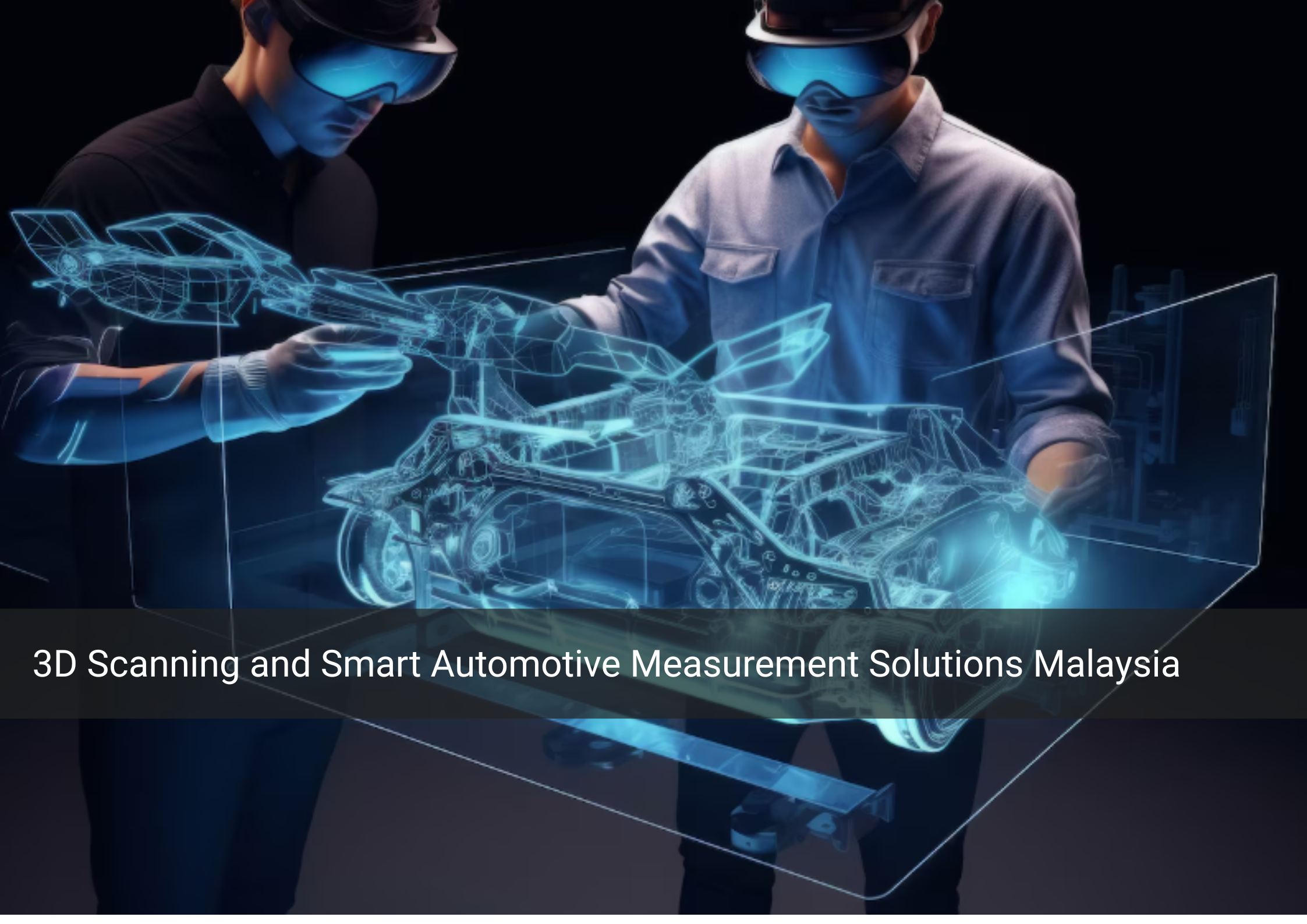
The automotive industry is rapidly adopting digital inspection technologies to improve speed, accuracy, and data reliability. Modern automotive measurement solutions Malaysia now integrate 3D scanning systems that allow manufacturers to capture complex geometries quickly and efficiently.
When combined with automotive test solutions Malaysia, 3D inspection creates a powerful framework for quality assurance and production validation.
Why 3D Scanning is Transforming Automotive Inspection
Traditional measurement tools are effective but may require longer setup times for complex parts. 3D scanning offers:
Fast full-surface data capture
Non-contact measurement
High-resolution geometric analysis
Digital comparison with CAD models
This makes automotive measurement solutions Malaysia more efficient, especially for body panels, molded components, and precision-engineered parts.
Applications in Automotive Manufacturing
3D scanning systems are widely used for:
Reverse engineering
Tooling and mold validation
First article inspection
Assembly alignment verification
Quality audits for mass production
Technology providers such as Hansvue support precision inspection environments with advanced optical and measurement systems suitable for automotive manufacturing facilities.
These technologies enhance dimensional accuracy while reducing manual inspection errors.
Integrating Measurement with Performance Testing
Inspection alone is not sufficient. After dimensional verification, components must undergo strength and durability testing.
By integrating automotive test solutions Malaysia, manufacturers can perform:
Material strength validation
Fatigue and load testing
Hardness testing
Structural stress evaluation
Material testing systems from providers like Victor Material complement 3D measurement processes, ensuring that components are not only dimensionally accurate but also mechanically reliable.
This integrated approach reduces product failure risks.
Data-Driven Automotive Quality Control
Modern automotive environments rely heavily on digital data. 3D scanning systems produce detailed reports that can be integrated with:
Statistical Process Control (SPC) systems
Production monitoring dashboards
Quality documentation systems
Laboratory and analytical equipment suppliers such as JS Analytical also support industrial testing environments where material verification and analytical validation are required alongside measurement systems.
The combination of measurement data and test results creates a comprehensive quality management system.
Conclusion
As automotive designs become more complex, advanced inspection technologies are essential. Implementing 3D-enabled automotive measurement solutions Malaysia improves inspection speed, accuracy, and digital traceability.
When combined with robust automotive test solutions Malaysia, manufacturers can achieve complete validation—from dimensional precision to mechanical performance.
Smart inspection is no longer optional—it is a strategic advantage in modern automotive production.